

Football
How did Kane win the Ballon d'Or without the Champions League trophy?
30 October 2026
In today's Strop, we explain how Harry Kane won football's biggest individual award without its biggest club trophy, and what that tells us about how the Ballon d'Or is really decided.
The Story
If you stayed up past midnight on Monday, you saw Harry Kane walk on stage at the London Palladium and lift the Ballon d'Or, football's best-known award for the best player of the season. He is the first Englishman to win it since Michael Owen in 2001.
For many fans watching from India, the win came with a nagging doubt. Kane's club, Bayern Munich, were knocked out of the Champions League (Europe's top club competition) in the semi-finals. The two clubs who reached the final in May were Paris Saint-Germain and Arsenal, and Kane played for neither. So how does a player win the season's biggest individual prize without its biggest club trophy?
The short answer is that the Champions League has never been the entry ticket most of us assume. The longer answer tells you a lot about how this award is actually decided.
Start with history. Since the award began in 1956, most of its winners did not lift Europe's top club trophy in the season they were honoured. The chart below shows just how many.
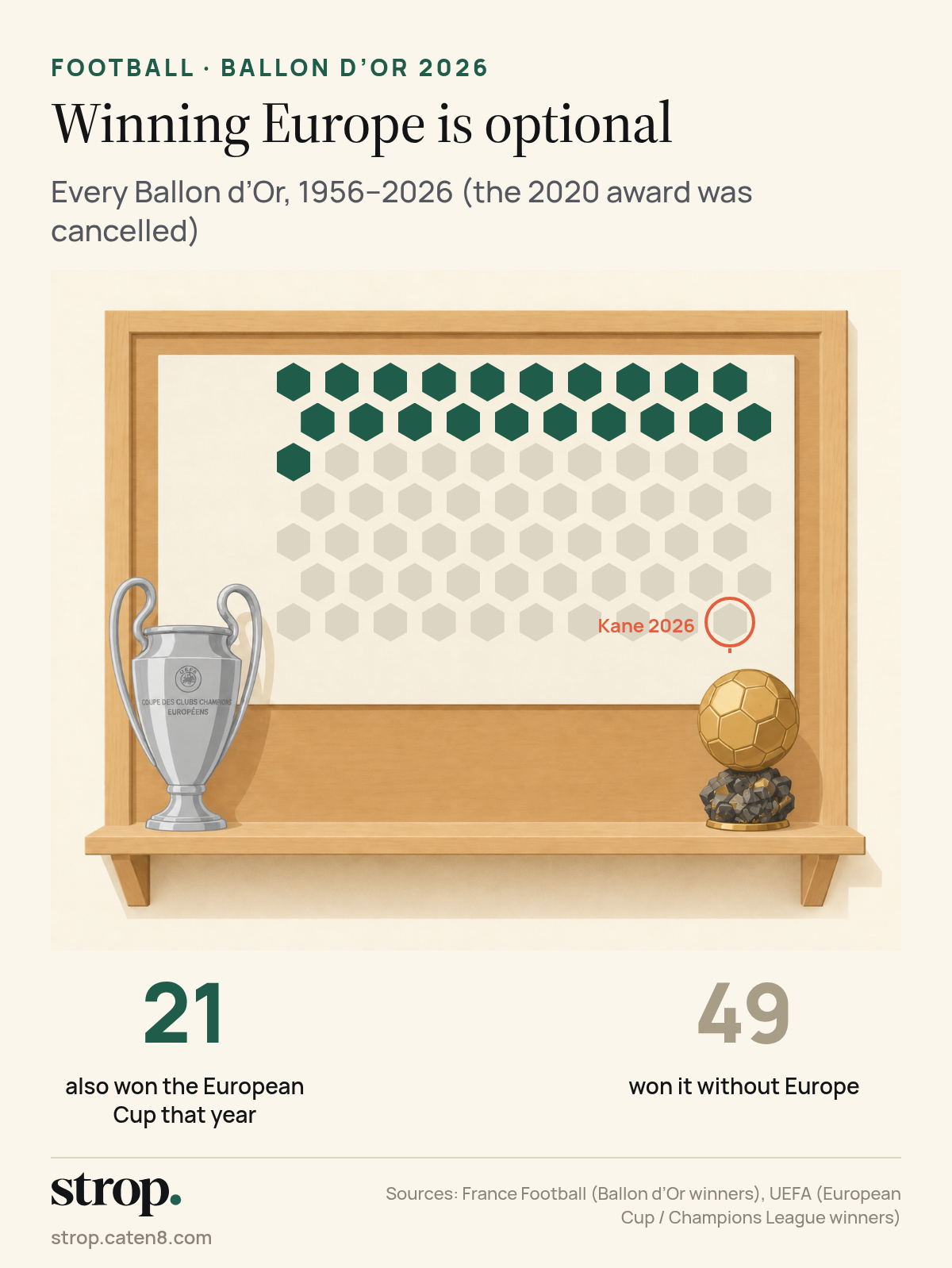
Recent winners follow the same pattern. Lionel Messi won in 2019, 2021 and 2023 without a Champions League medal in any of those seasons, and Rodri won in 2024 the same way. Kane is simply the latest name on that list.
Which raises the obvious question. If the voters are not looking for that one trophy, what are they looking for?
France Football, the French magazine that runs the award, gives its jurors three things to judge, in a set order. First comes individual performance: goals, assists, and how often a player decided the big games. Second comes team success and trophies. Third comes class and fair play. Jurors also judge just one season, which this time ran from August 2025 to July 2026. A player's fame, career or past near-misses are not supposed to count at all.
Think of it like a school's student-of-the-year award, rather than the trophy for whoever wins the inter-school final. Winning the final helps you get noticed. But a student who topped every exam all year can still take the bigger prize, even if their team lost in the semis.
By that first test, Kane's season is hard to argue with. He scored 73 goals for Bayern and England, more than any player in Europe. Bayern won the Bundesliga (Germany's top league) and the German Cup, and Kane scored a hat-trick in the cup final. He even helped knock Real Madrid out of the Champions League, in an April quarter-final that Bayern won 6-4 over two matches.
Then came the summer. At the World Cup, Kane scored six goals, passing Gary Lineker as England's top scorer at World Cups, and captained England to third place. That was their best finish since they won the tournament in 1966.
So Kane's trophy cabinet was far from empty. It was just missing the one trophy that usually dominates the conversation. But there's a catch, and it is the man who finished second.
Kylian Mbappé scored 50 goals for Real Madrid and France, and was the Champions League's top scorer with 15. On the first test, he ran Kane very close. On the second, he had little to show: Real won no major trophy, and France lost the World Cup's third-place match to Kane's England. Without a Champions League of his own, Kane's two domestic trophies and a World Cup medal were enough to tip the balance.
And it really was a balance. Vincent Garcia of France Football called the gap between the two "extremely small", and said Mbappé led for most of the voting period before Kane came back strongly. Lamine Yamal, who won the World Cup with Spain and La Liga (Spain's top league) with Barcelona, finished third. Garcia believes the Spanish jurors split their votes between him and his teammate Rodri, which may have cost him points.
This is where the scoring system we explained on Monday comes in. Each juror ranks 10 players, and first place earns only a few more points than second. So a player who sits near the top of almost every ballot can beat one who collects more first-place votes but divides opinion. Kane, strong on both tests, was exactly that kind of candidate.
Is that fair? Some fans will argue that a season without Europe's top club trophy should not beat one with a World Cup winner's medal, which Yamal has. Others will say the rules worked as written: they reward the player who was excellent for the longest, not the one who shone in a single final. Both views fit the criteria, which is partly why the vote was so close.
There is one more reason the win felt bigger than a single season. Until May 2025, Kane had played around 600 games as a professional without winning a major trophy, losing a Champions League final with Tottenham in 2019 and two European Championship finals with England. The jury was not supposed to weigh any of that. But it explains why the Palladium cheered so loudly.
France Football is due to publish the full points table this Saturday. Watch the gap between Kane and Mbappé, and how many jurors put Kane first. If it is as narrow as Garcia suggests, this year's Ballon d'Or was decided less by one missing trophy than by second and third places on ballots around the world. None of them, as we explained on Monday, were cast from India.