

Football
Who picks the Ballon d'Or, and why can't India vote?
26 October 2026
In today's Strop, we explain who decides football's most famous individual award, and why there is no Indian in the room.
The Story
The Ballon d'Or will be handed out at the London Palladium tonight, at 12:30 India time. It is the award's 70th year, and the first time the ceremony has come to London.
The favourites are familiar. Harry Kane leads the betting, ahead of Kylian Mbappé and Lamine Yamal. So who actually decides between them, and why is nobody from India in the room?
Journalists decide, one per country, and a country only gets a journalist if its men's team is ranked in the world's top 100. India isn't, so India has no vote. How that jury works also explains why a player who wins fewer trophies can still win.
The Ballon d'Or is run by France Football, the French magazine behind the award. It is voted on by journalists, one from each country in the top 100 of FIFA's men's world ranking. Players and fans have no vote, and since 2016 national team coaches and captains no longer vote either.
India has spent this year well outside that top 100, and was ranked 136th in April. A country where millions stay up for European football has no juror tonight.
No ranking, no ballot.
Each juror picks 10 players from a shortlist of 30 and ranks them. First place earns 15 points, second gets 12, third 10, and so on down to one point for tenth. The player with the most points wins. If two players tie, the one with more first-place votes takes it.
Jurors are told to weigh three things, in this order: individual performances, then team performances and trophies, then class and fair play. Only one season counts, this year from 3 August 2025 to 19 July 2026. A player's career doesn't count at all.
The votes are already in. Jurors had until 28 September to send their lists, so tonight's ceremony only reveals a result that was settled a month ago. The women's award uses a smaller jury of 50 journalists from the top-ranked nations, chosen the same way.
The points scale matters more than it looks. The gap between first and second is only three points, so a player who sits near the top of almost every ballot can beat one who splits opinion.
A worked example makes it clear. A player ranked second by all 100 jurors gets 1,200 points. A rival ranked first by 60 jurors and fifth by the other 40 gets 900 plus 280, which is 1,180. The player nobody put first wins.
College interview panels run on the same arithmetic. The student every member ranks second can finish ahead of the one half the panel loves and the other half barely notices.
Now the three favourites. Kane scored 73 goals for Bayern Munich and England last season and won the Bundesliga (Germany's top league) and the German Cup, but not the Champions League or the World Cup. Few jurors will leave him off their list.
Mbappé won the World Cup's Golden Boot (top scorer award) with 10 goals, but no trophy. Yamal, at 19, won the World Cup with Spain and La Liga with Barcelona, but missed weeks with a hamstring injury. Both are likely to split the room more than Kane.
A jury of journalists is simple and hard to game. It also means the size of a country's football audience counts for nothing. Only its team's results do, which is why India has no say.
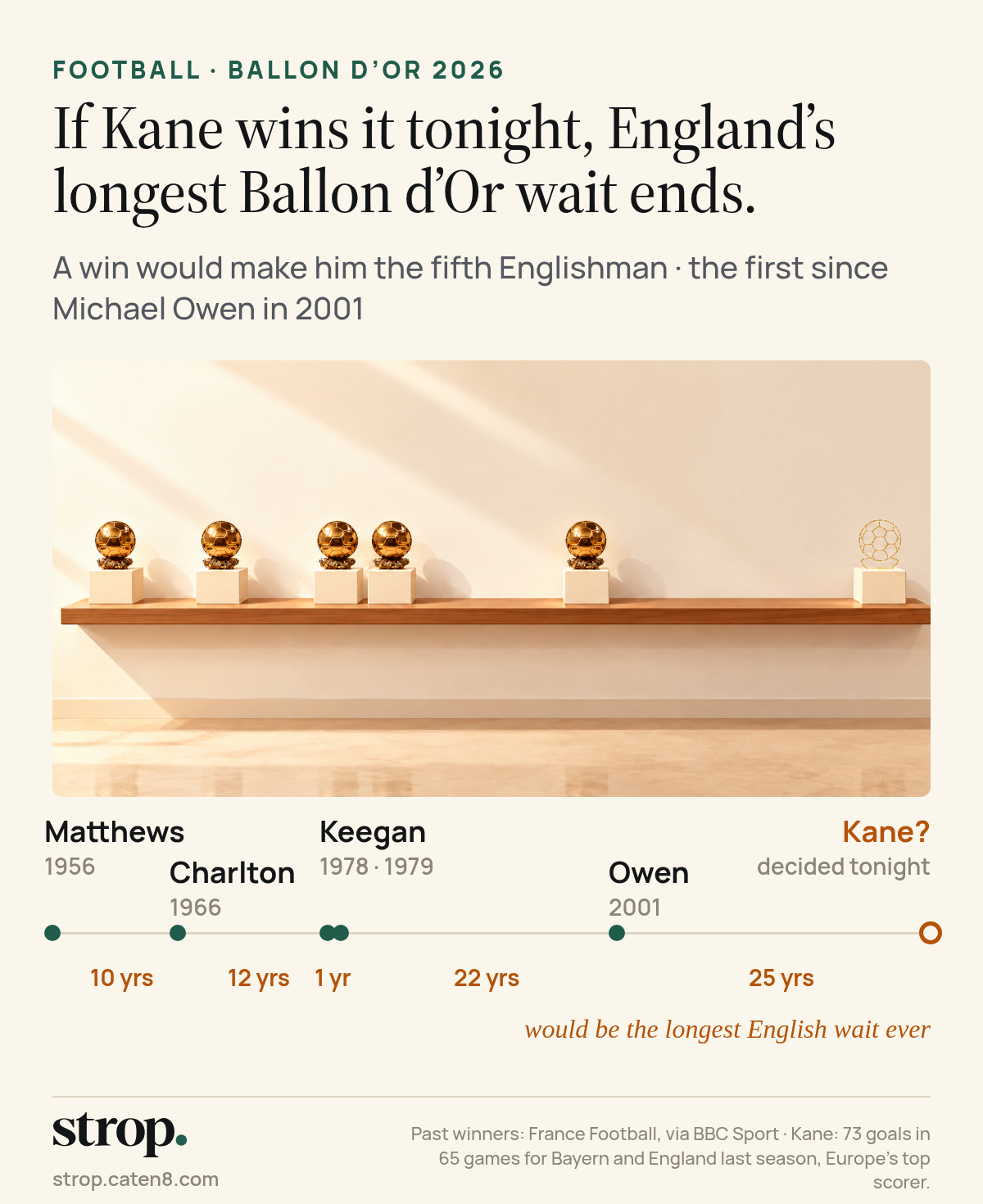
If Kane wins, he will be the first Englishman to win since Michael Owen in 2001. The timeline below shows how rarely England has produced a winner.
Whoever wins tonight will have been picked by a jury with no Indian voice. The day India's men climb into the top 100, an Indian journalist gets a ballot, and for now that may be the most realistic Ballon d'Or India can win.