

Football
Who is paying for Indian football now?
2 November 2026
In today's Strop, we explain who now pays for the Indian Super League, why nobody wanted to buy it a year ago, and what that tells us about the money in Indian football.
The Story
If you stayed up on Sunday night for Liverpool against Arsenal, you had plenty of company. Late-night European football is a habit for lakhs of fans across India. Now try a harder question on the same group chat: who won the Indian Super League last season, and is it even on right now?
It is on. The ISL, India's top football league, kicked off its new season on 10 October, with East Bengal as champions after their first ISL title last season. For many fans, even that will be news. The bigger story is how close the league came to not returning at all, and who is paying for it now.
The short answer is the clubs themselves, because nobody else wanted the job. The longer answer shows just how small the money in Indian football is, once you set it next to the sport India watches most.
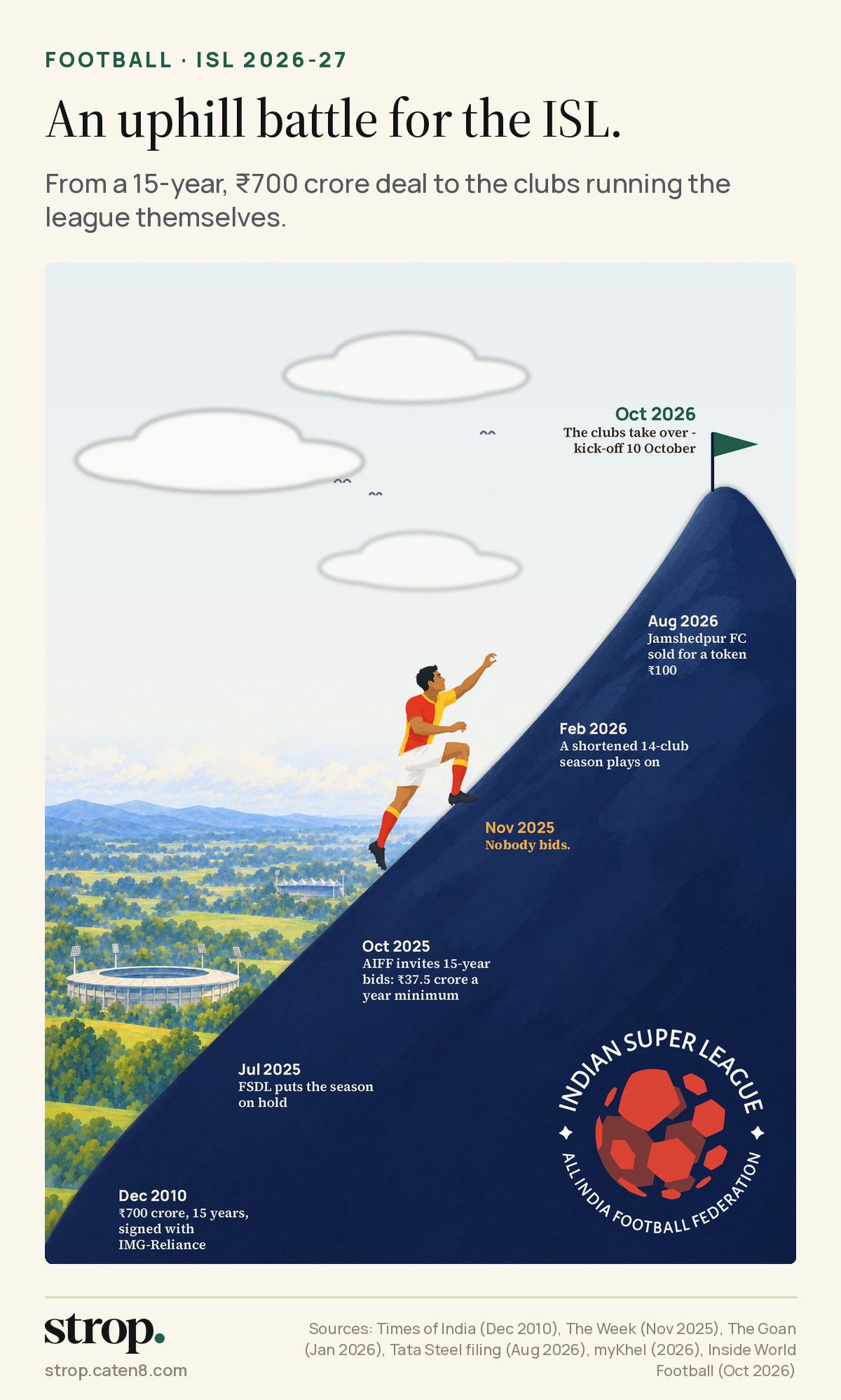
Start with how the league used to work. In 2010, the All India Football Federation (AIFF, Indian football's governing body) handed the league's commercial rights to Football Sports Development Limited (FSDL), a Reliance-backed company, in a 15-year deal worth ₹700 crore. FSDL ran the ISL, sold its TV rights and sponsorships, and paid the federation about ₹50 crore a year.
That deal was due to end in December 2025. A Supreme Court case over the federation's constitution froze any renewal, and in July 2025 FSDL told clubs the new season was on hold. Several clubs suspended first-team training, and some delayed salaries for players and staff.
Then came the moment that says the most. In October 2025, the federation invited bids for a 15-year partner to run the league, at a minimum of ₹37.5 crore a year. It received no bids at all. The league was on its own.
If the price was so low, why did nobody want it? Think of a shop on a quiet lane. The rent may be cheap, but if few customers walk in, even cheap rent is too much. Bidders would also have had to pay for production, marketing and grassroots football, and would have held only one of six seats on the league's governing council. Industry experts quoted by The Week called the fee commercially unviable.
What followed was a stopgap. A shortened season began on 14 February 2026, with each of the 14 clubs playing the others only once. Because clubs could not reach the 24 matches that Asia's football body requires, India lost its direct places in Asian club competition.
So who runs the ISL now? From this season, the clubs do. Under a new club-led model, each club paid the federation ₹1.1 crore to take part, the clubs handle TV and sponsorship together, and the federation only runs the competition. One club could not pay: Diamond Harbour, whose story we told earlier.
By that first test, with the money coming in, there are signs of life. MG Motor is the league's first title sponsor in three seasons, in a deal worth ₹25 crore over two years. Sony shows matches on TV, and every match is free on YouTube, where clubs are reportedly paid by views and engagement. The value of the Sony deal has not been disclosed.
But there's a catch, and it is the league next door. Tata pays ₹2,500 crore over five years to put its name on the IPL, about ₹500 crore a year. That is 40 times what MG pays the ISL. A single IPL match is worth about ₹118 crore to broadcasters, more than three times the yearly fee nobody would pay for the whole ISL.
Europe is further away still. Premier League clubs earned £3.4 billion from broadcasting last season alone, about half of all their income.
The clearest price tag came in August. Tata Steel agreed to sell Jamshedpur FC, a top-flight club with a turnover of ₹32.23 crore last year, to Churchill Brothers for ₹100. That is less than a cinema ticket.
Is that comparison fair? Some fans will say no. The IPL is a two-month festival built on India's national team stars, while the ISL runs for eight months and competes with the Premier League on the same phones. Others will argue that a free YouTube stream gives away the little value the league has. Supporters of the model reply that a league people don't know about must first be seen, and free is how you get found.
The first real test arrives as the season moves towards its finish in May. Watch the YouTube numbers the clubs report, and whether any big sponsor joins MG. If the audience grows, the clubs will have proved that a league nobody bid for can still pay its way. If it doesn't, Jamshedpur may not be the last club sold for the price of a samosa plate.