

Wrestling
Do Youth Olympic champions become Olympic champions?
9 November 2026
In today's Strop, we explain how often Youth Olympic champions go on to win Olympic gold, and why some of this year's medals, including India's, can't lead there at all.
The Story
On a stretch of sand at Saly, a beach town south of Dakar, there is no mat and nobody wears shoes. Wrestlers fight barefoot inside a circle drawn in the sand, and a bout is settled by a handful of points.
On Saturday, an Indian teenager named Taniya won four bouts in a row there, then lost the final 2-1 to China's Zhao Min. Her silver in the women's 75kg is India's first beach wrestling medal at the Youth Olympic Games (the Olympics for teenagers), which run in Senegal until 13 November.
It is a medal worth celebrating, and it brings back the question every Youth Olympics raises. Will we see these teenagers on an Olympic podium in a few years? Put plainly: do Youth Olympic champions actually go on to become Olympic champions?
Some do, and a few have become the biggest names in sport. Most don't. And some of this year's medallists can't, because their sport isn't at the Olympics at all. Beach wrestling is one of those. To see how this works, we need to look at what the Youth Olympics are for, then at what happened to the champions who came before Taniya.
The International Olympic Committee (IOC, the body that runs the Olympics) started the Youth Olympics in Singapore in 2010, then took them to Nanjing in 2014 and Buenos Aires in 2018.
Dakar was meant to host in 2022 but the pandemic pushed it back, so this is the first Olympic event ever held in Africa. The IOC calls it a platform for the next generation, and the 25 sports in Dakar show it: next to athletics and swimming sit sports it is still trying out.
Several of them won't be at the next Olympics, in Los Angeles in 2028. Beach wrestling, wushu (Chinese martial arts, judged on form), baseball5 (a five-a-side street version of baseball, hit with the hand), beach handball and futsal (five-a-side indoor football) have no place there.
Breaking, the dance sport that made its Olympic debut in Paris, has already been dropped for Los Angeles. Coastal rowing goes the other way: its beach sprint races join the Olympics in 2028.
For India this is no side issue. Four of the 17 athletes we sent to Dakar are beach wrestlers, and Rajkumari Lanchenbi Chanu's bronze in wushu on 3 November also came in a sport with no Olympic place yet.
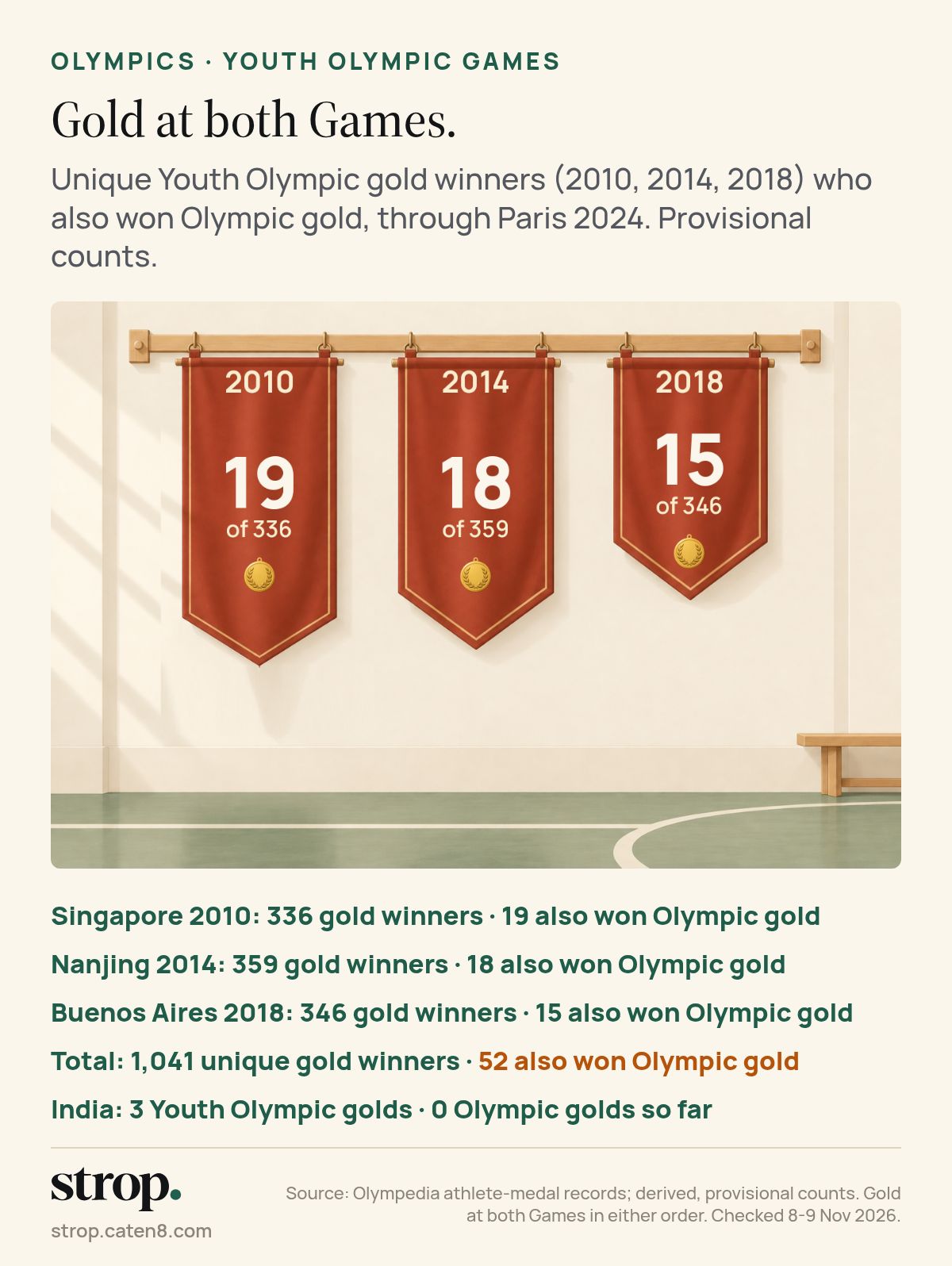
So what about the champions whose sports are on the Olympic programme? Here the record surprises most people. The first three Summer Youth Olympics held about 660 medal events between them. According to a running list of those champions, at least 44 have since won Olympic gold. That is roughly one in 15. The chart below shows how they split by edition.
The names on that list are big ones. Emma McKeon, the Australian swimmer, won relay gold at the first Youth Olympics in 2010, then Olympic gold at three Games.
Noah Lyles won the 200m in Nanjing in 2014 and the 100m, the most-watched race at any Olympics, in Paris in 2024. Japan's judoka Hifumi Abe and China's table tennis star Fan Zhendong were also 2014 champions. The newest class is still catching up: 10 champions from 2018 have done it so far, against 19 from 2010, simply because they have had fewer Olympics to try.
Where does India sit? We have won 23 Youth Olympic medals across the first three editions, three of them gold, all in Buenos Aires. None of those three champions has won Olympic gold yet. Saurabh Chaudhary, the 2018 boys' air pistol champion, reached the Olympic final in Tokyo and finished seventh. Jeremy Lalrinnunga, the weightlifting champion that year, went on to win Commonwealth Games gold in 2022 but not an Olympic medal.
The Olympic medals that did come grew from the same group. Manu Bhaker, the 2018 girls' air pistol champion, won two bronze medals in Paris, the first Indian to win two medals at one Games since independence.
Vivek Sagar Prasad and Sanjay, both in the hockey team that took Youth Olympic silver in 2018, were part of the side that won bronze in Paris. Lakshya Sen, a Youth Olympic silver medallist in singles, came fourth there. So far, India's road from the youth podium to an Olympic medal has run through shooting and hockey.
Neither is in Dakar. In December 2024, the IOC moved shooting, weightlifting and hockey out of the medal programme and into a non-medal "engagement" programme. In Buenos Aires those three sports gave India seven of its medals, including all three golds. India came to Senegal without the events that had carried it, and its medals have come from elsewhere: swimming, wushu, beach wrestling.
Think of the Youth Olympics as a Class 10 board topper list. Topping the boards says you are talented and well taught at 16. It doesn't promise a top rank in the JEE two years later, where the paper is harder, the whole country is in the hall and some toppers pick a different path. The Youth Olympics add one more twist: a few subjects on the board paper don't appear in the entrance exam at all.
That makes it tempting to call a medal like Taniya's a dead end, and the view has a point. A beach wrestling silver can't become an Olympic beach wrestling medal, because there isn't one.
The opposite view is just as reasonable. Beach wrestling draws on the same balance, grip and timing as freestyle wrestling, which is an Olympic sport, so none of that work is wasted. And a sport can grow without the Olympics, as pickleball has, which we explained on Friday. Which side you take depends on what you think a youth medal is: a forecast, or a first step.
There is also a teenager at the centre of this. Taniya won four bouts on sand, far from home, in a sport most of India had not heard of a week ago, and lost the final by a single point. Whatever the record books say about Youth Olympic champions, that silver belongs to her, and it is the first one Indian beach wrestling has.
By the end of Saturday, India had seven medals in Dakar, three silver and four bronze, with the Games closing on Friday.
The bigger test comes later, at Los Angeles in 2028 and Brisbane in 2032. Keep an eye on which of this year's medallists move into Olympic sports as seniors, and on whether shooting and hockey return to the next Youth Olympics. If they do, India's best-tested route from a youth medal to an Olympic one reopens. If they don't, the next Manu Bhaker will have to find another way up.