

Pickleball
Why is everyone in India suddenly playing pickleball?
6 November 2026
In today's Strop, we explain why pickleball spread so quickly through Indian cities, what Strop's own venue list shows about the boom, and who now runs the sport.
The Story
Over two days last weekend, players at Stryde Arena in Guwahati competed in 16 categories for a place in Assam's team at the national pickleball championship. The winners now head to the Indian Pickleball Association's Nationals. A few years ago, most of India had not heard of the sport, let alone picked teams for it.
You have probably noticed the change too. A colleague books a court every Thursday, a cousin's housing society has painted lines on its terrace, and the family group chat has a new question: what is pickleball, and why is everyone suddenly playing it?
Mostly, it fits Indian city life almost perfectly. It needs little space, little money and almost no skill to start, and it is easy to play with people you have just met. But the clearest sign of how big it has become is not in the players. It is in where the courts have appeared.
Start with where the game came from. Pickleball was invented in 1965 on Bainbridge Island near Seattle, by three fathers looking for a game for their bored children. It reached India in 2006, when Sunil Valavalkar brought it back from Canada. Early interest was thin, and in 2008 he set up the All India Pickleball Association to keep it going.
The game itself takes five minutes to learn. Two or four players hit a light plastic ball full of holes with solid paddles, over a net slightly lower than a tennis net. The court is 20 feet by 44 feet, the same size as a badminton doubles court. Serves are underhand, only the serving side can score, and games usually run to 11 points.
Although, there is one rule that makes it tactical. A seven-foot strip on each side of the net, called the kitchen, is a no-volley zone, so you cannot stand at the net and smash every ball. Points become patient rallies of soft shots, which is why a beginner can keep up with a better player for longer compared to tennis.
Now let's talk about the space. A single tennis court can be split into four pickleball courts. Think of a bungalow plot rebuilt as four flats: the same land suddenly serves four times as many families. For a club, a school or a rooftop owner in a crowded Indian city, that arithmetic is hard to ignore.
Strop's own venue list shows how far this has gone. Of the 3,723 places to play we list across seven cities, 791 offer pickleball. In Delhi NCR, more venues on Strop list pickleball than badminton, 101 against 91. In Mumbai the gap is wider, 76 against 34. The chart below shows the count in each city.
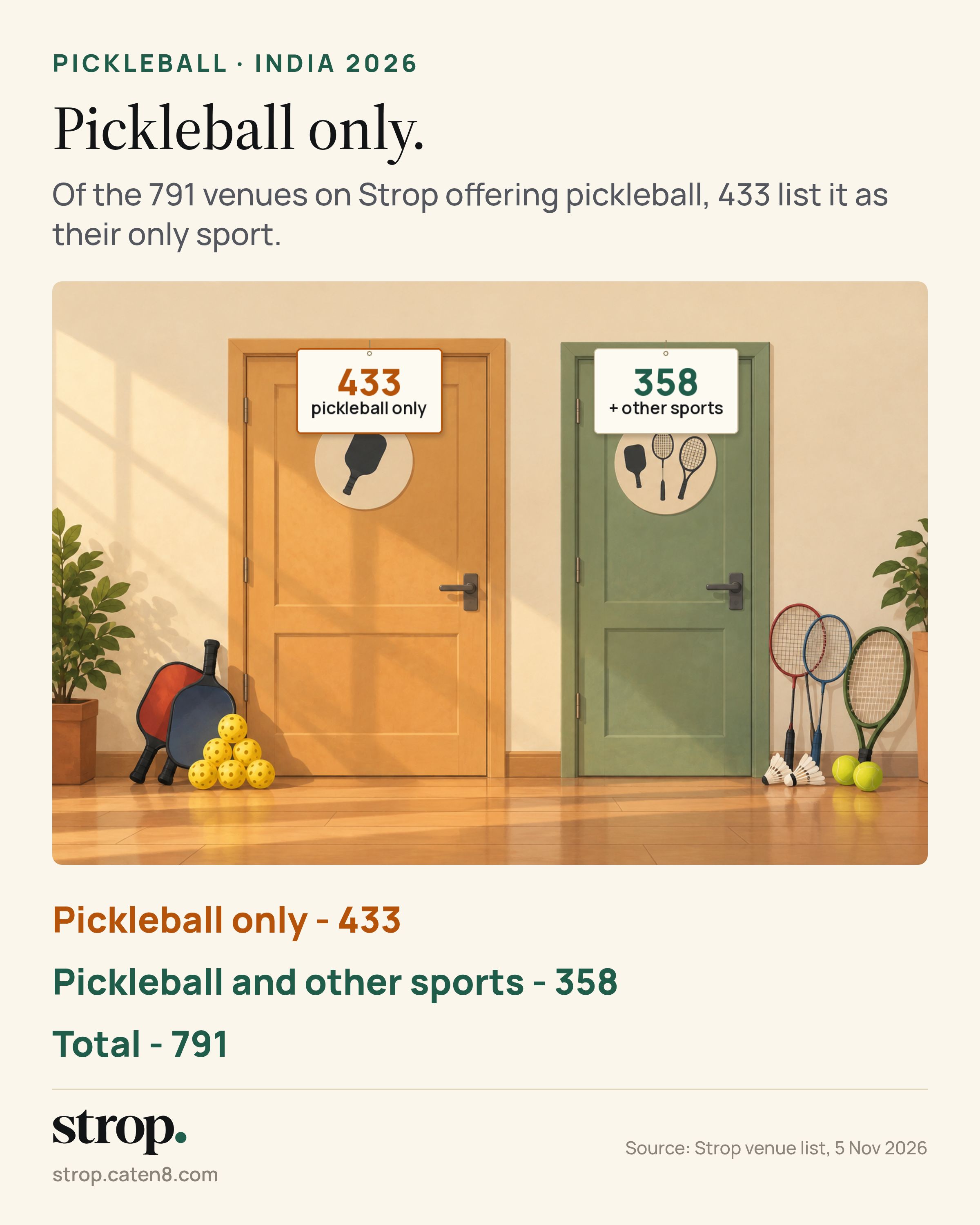
More than half of those 791 venues (~433) list no other sport at all. That matters, because it means most of these courts were built for pickleball, not borrowed from a badminton hall for an hour in the evening. People do not spend money on dedicated courts for a fad they expect to fade.
So who is paying for all of this? Players, mostly, and the businesses around them. Franklin Sports, a ball and paddle maker, told The Week it sells about 50,000 pickleballs a month in India, and that its annual sales here have grown from ₹5 lakh a decade ago to ₹4 crore. A starter paddle can cost about ₹1,000, while serious players spend ₹20,000 or more on one.
The sport now has its own stage too. The World Pickleball League, a franchise league with city teams, played its first two seasons at Jio World Garden in Mumbai in 2025 and 2026, mixing Indian and international players. Film stars and business families playing on camera have helped, but the courts came first: even in 2024, 40 to 50 new courts were opening every month.
But there's a catch, and it is about who runs the sport. In April 2025, the sports ministry recognised the Indian Pickleball Association as the national federation, even though it was registered only in November 2024. The older All India Pickleball Association challenged that, arguing the rules require a body to have existed for three years. The Delhi High Court dismissed its petition, saying recognition is a policy decision for the ministry.
For players this has a practical implication. Both bodies run tournaments of their own, and a young player chasing a national title needs to know which championship counts. The Guwahati trials were for the IPA Nationals, run by the body the ministry now recognises.
Is the boom as big as it looks? The AIPA has claimed more than five lakh active players in India, a figure we could not check independently. One view says pickleball is riding a wave of novelty and celebrity videos, and some courts will empty when the next craze arrives. The other says the reasons it spread - small courts, cheap entry and easy company - will still be true next year. Both fit the numbers we have today.
The results are already real. At the Pickleball World Cup in Da Nang, Vietnam, in September, India finished fourth on the medal table with 41 medals. For a sport that arrived in one man's luggage 20 years ago, that is quick progress.
Watch out for two things over the next few months: the IPA Nationals, where Assam's new team will play, and whether new courts keep opening in smaller cities. If they do, the question will change from why everyone is playing pickleball to where you can still find a free court on a Thursday night.